Descending Into the
Unknown
A voyage beneath the surface — where sunlight fails, pressure crushes steel, and life invents itself anew. Explore the ocean's deepest, least-mapped frontier.
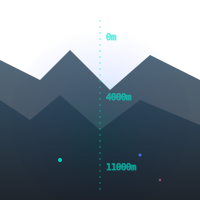
The hadal zone holds trenches deeper than Everest is tall
Below 6,000 metres lies the hadal zone — narrow trenches plunging another 5 km into the crust. Pressure here exceeds 1,100 atmospheres, yet snailfish, amphipods, and microbial mats thrive in conditions once thought to forbid life entirely.
Most life in the deep ocean glows in the dark
Below 200 metres, sunlight fails — and creatures answer with their own light. An estimated 76% of midwater animals produce bioluminescence, using light to hunt, lure, signal, or vanish. It is the most common form of communication on Earth.
Whole ecosystems run on chemistry, not sunlight
Around volcanic vents on the seafloor, super-heated water rich in hydrogen sulphide feeds chemosynthetic bacteria — the base of food webs that sustain tubeworms, blind crabs, and ghost shrimp. Life without the sun, thriving in absolute dark.
Deep-sea mapping AI
Neural sonar models stitch terabytes of multibeam returns into seafloor atlases, charting trenches and seamounts at 100m resolution — work that took a century, now done in months.
Marine genomics
Environmental DNA sampled from a single litre of deep water reveals hundreds of unseen species, rewriting the catalogue of life faster than expeditions ever could.
Autonomous submersibles
Untethered AUVs navigate kilometres beneath the surface, carrying cameras and samplers into chasms no human-rated craft can reach — and returning with the first images of new worlds.